ABOUT
Dennis Santarinala (born 1976 in Pasig City, Metro Manila) is a Filipino American photographer and filmmaker based in Vacaville, California. He grew up in Cainta, Rizal, attended Lourdes School of Mandaluyong, and studied at the Philippine School of Interior Design before moving to the United States. He later earned degrees in Media Arts and Graphic Design from Platt College San Diego and currently works in U.S. Air Force Public Affairs.
His photography moves between conceptual fine art and social documentary, with a focus on people, culture, place, and human behavior. He is drawn to gestures, relationships, humor, contradictions, and small details that reveal something about the people and places he encounters. His influences include Jim Marshall, Sebastião Salgado, and Robert Frank, particularly Frank’s observations of American life in The Americans. Early in his photography career, Dennis assisted photographer David Leslie Anthony during his Von Dutch campaigns and considers Anthony his first photography mentor.
Dennis served in the U.S. Navy from 2002 to 2007, working in naval aviation maintenance and later with the Navy’s early MQ-8 unmanned helicopter program. In 2004, he deployed aboard the USS Abraham Lincoln during Operation Unified Assistance following the Indian Ocean tsunami, where he photographed the people and humanitarian mission around him. He later served in the U.S. Army from 2010 to 2013.
His photography, filmmaking, and multimedia work have received multiple Air Force Reserve Command honors, including 2024 Digital Art of the Year, 2023 Multimedia Product, Portrait, and Video Story of the Year, and 2022 Multimedia Product of the Year. His professional work includes documentary photography, filmmaking, and visual storytelling for U.S. Air Force Public Affairs. He is also developing a field based visual storytelling curriculum for Air Force Reserve Command Public Affairs professionals, centered on recognizing stories, understanding why they matter, working effectively in the field, and producing complete visual narratives.
Dennis has exhibited work in the United States and the Philippines. His ongoing documentary project in the mountainous province of Abra in Northern Luzon follows the legacy and unfinished work of his aunt, Puraperla “Pura” Sumangil, and the women who worked alongside her. An educator, community organizer, social activist, and longtime member of the Auxiliaries of the Apostolate, Sumangil co-founded the Concerned Citizens of Abra for Good Government, an organization recognized for citizen monitoring of government projects and public accountability. She received the Aurora Aragon Quezon Peace Award, was among the Filipino women included in the 1,000 women nominated for the 2005 Nobel Peace Prize, and later received the Pro Ecclesia et Pontifice papal honor for service to the Catholic Church.
Dennis began photographing women who worked alongside his aunt, including members of the Auxiliaries of the Apostolate and women from Indigenous Tingguian communities. The project continues through repeated visits to Abra, documenting their lives, stories, and the people carrying forward decades of work in education, good governance, community development, and peace advocacy. It is also an effort to preserve a history that often exists through the memories of the people who lived it.
He is also developing a long term project returning to Banda Aceh, Indonesia, where he photographed Operation Unified Assistance in 2004. More than twenty years later, the project will revisit the place and document survivors of the tsunami, the communities that rebuilt afterward, and people connected to the humanitarian mission.
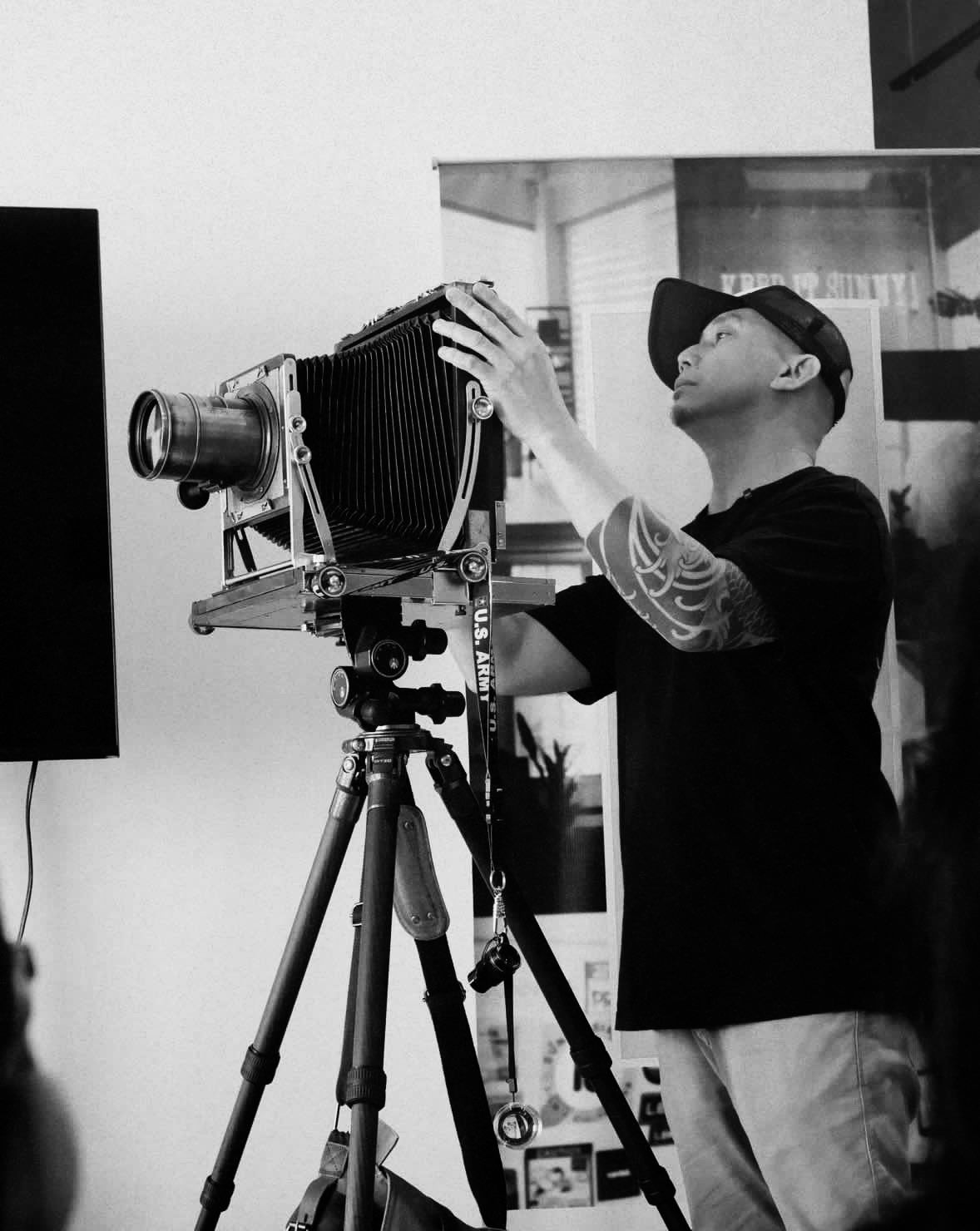
Dennis works across digital photography, 35mm and medium format film, Super 8, 16mm, and historic processes including wet plate collodion. His cameras include Leica M3, M4, and M6 rangefinders, Hasselblad 500 series cameras, Rolleiflex TLRs, the Leica M10 Monochrom, and a Bolex Rex 5. In his professional Public Affairs work, he uses Nikon systems for still photography and Sony systems for video production. The choice of camera, lens, and format is deliberate, with each becoming part of the visual language of a project rather than simply a means of recording it.
Dennis is particularly drawn to the 28mm focal length. Its wider field of view requires him to work close, where he feels less like someone looking into a scene and more like a participant within it. At that distance, the frame becomes less predictable. Layers begin to come alive. People, gestures, foreground, background, movement, and chance all have to coexist, and sometimes collide, within a single photograph.
The closer he works, the greater the possibility of failure. A step in either direction can change the entire frame. Elements appear and disappear quickly, relationships form for fractions of a second, and the photographer has to recognize when those independent pieces are beginning to work together. It demands anticipation, awareness, and a willingness to lose photographs while looking for the one moment when everything aligns. For Dennis, that risk is part of what makes the process rewarding.
He believes documentary photographers should understand their own position within what they photograph. A photographer can remain a careful observer at a safe distance, work as a close observer within the scene, or become a participant willing to accept some of the same uncertainty and risk unfolding around them. Each position changes what the photographer can witness and, ultimately, what kind of photograph can be made.
Distance is not neutrality, and proximity alone does not make a photograph truthful. What matters is knowing where you stand, why you are there, and what you are willing to risk to make the frame.
CONTACT
Military assignments on DVIDS:
Dennis Santarinala DVIDS Portfolio
Instagram: @the_denshow
Assignments, editorial work, collaborations, commissions, and workshops:


